Tuesday, March 6, 2007

Fulla Girl in a Mulla World!


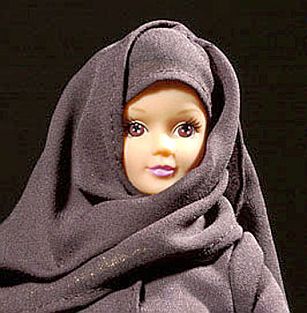
Until yesterday afternoon Fulla was a fluffy beautiful white cat that I get to host every time my mother leaves town. Exit Fulla the cat and enter Fulla the veiled Barbie!!!! I heard of this Barbie in passing by a friend of mine. It was mentioned as an ingenious idea in the proper formation of young Moslem girls.

After doing little research, I discovered how out of touch I have been. Fulla the sexy, oops I mean the wholesome chic, had been introduced in Moslem markets for few years now. I was not aware of it, maybe because I stopped playing with Barbie long time ago and now I am busy competing with her in the battle of the sizes.

Why was I so annoyed by this piece of insignificant news? Why? Why? Why? Is it because it reeks of manipulation of a questionable trend that is on the rise? Or is it because it is reinforcing a sexist image of women while being targeted at a group that might deny the whole notion of women’s sexuality? Or is it because it confirms the ignorance of a large important segment of our society today called “young parents”? Or is it because this Fulla will never dream of having her Ken (or Saeed)?

What in the name of sanity is the message that the makers of Fulla are trying to convey? This concoction of sexism mixed with religious righteousness is a sick attempt to boost sales of a symbol that has invaded western culture and is now polluting our young kids’ minds. Aren’t parents aware that teaching their kids to follow Islam should come through the proper teachings of this great religion? Don’t they realize that using weak vehicles such superficial lessons, fear tactics, myths, Barbie dolls are nothing but a testimony of their failure to properly understand and instill the values of Islam?

I have nothing against the veil. In fact one of my favorite articles happens to be about a woman’s defense of it. What I abhor is the cheap shot aimed at the minds of young Arab girls by introducing such a stupid and manipulative idea. Besides, does this mean now that Barbie is yet another mode of pitting at a very young age one group against the other? Growing up we never thought of ourselves as Moslems and Christians. We never cared. Christians did their thing and we did ours. The tolerance we were brought up with is the very tolerance that is at stake with such dangerous notions as this Fulla doll.

I am just as appalled by "Fulla" the pseudo-Barbie as much as I was when I watched an Arabized version of an Oreo Cookie commercial (in Arabic Gulf accent). I appreciated and found cute the debate on what is the best way to eat an Oreo cookie when it was directed at the proper audience at the place where it originated: USA. However, when we start seeing the Barbiazation and the Oreozation of our day-to-day culture, I think it is time we stop and think for a second, where the hell have we gone wrong?

More important though is where the hell are we going?

Saturday, February 17, 2007

The Rules

I am not talking here about the rules mentioned in the famous book "the rules" on time-tested secrets for capturing the heart of Mr. Right; I am actually referring to an article on time-detested Americo-centric remarks for capturing the hearts of Mr. Wrongs as far as the Arab World is concerned.

Thomas Friedman, the journalist with the dubious agenda has finally figured out “Mideast Rules to Live by”. In an op-ed piece in the New York Times Friedman, whose early professional training included an internship at the CIA, is finally uncovering to us, Arabs, these rules.

For anyone who has ever doubted the objectivity of Mr. Friedman, this piece should be enough to shed light on the deep seeded contempt that he holds for the Arabs. Constructive criticism is always welcome. However, when ridiculing a whole nation that is suffering on daily basis thanks to the meddling of outsiders (Friedman's fellow citizens, be it Americans or Israelis) in its own affairs with the objective of stripping it of its wealth is summarized into non-sensical rules, the issue becomes worthy of rebutting.

Some of the rules as mentioned (comments in Italic):

Rule 1: What people tell you in private in the Middle East is irrelevant. All that matters is what they will defend in public in their own language. Anything said to you in English, in private, doesn’t count. Maybe Mr. Friedman should not have been addressed nor entertained in private to start with.

Rule 2: Any reporter or U.S. Army officer wanting to serve in Iraq should have to take a test, consisting of one question: “Do you think the shortest distance between two points is a straight line?” If you answer yes, you can’t go to Iraq. I love the doublespeak in the use of word “serve”. Well let’s make a long story short, whether it is serving or spying or stealing or hostile taking-over, or holding a whole nation hostage based on bogus pretexts, or a straight versus crooked line is irrelevant. The relevant issue here is that these “services” rendered by the Americans are no longer required nor welcomed.

Rule 3: If you can’t explain something to Middle Easterners with a conspiracy theory, then don’t try to explain it at all — they won’t believe it. I wonder what Mr. Friedman means by “you”. Sensing the narcissism and arrogance reeking from his piece, he is probably referring to himself. As for the reference to conspiracy, maybe Mr. Friedman should check with April Gillespie on why these simplistic people are thinking along a “conspiracy” line.

Rule 4: In the Middle East, never take a concession, except out of the mouth of the person doing the conceding. If I had a dollar for every time someone agreed to recognize Israel on behalf of Yasir Arafat, I could paper my walls. A much appreciated Freudian slip. Now Mr. Friedman is talking like the true advocate of Israel that he is. I suggest he starts collecting a dollar for every innocent Palestinian killed, injured, tortured, or robbed of his basic rights by the Israelis. This would not only provide him with enough dollars to cover his wall, but would instead make him a very rich man.

Rule 5: Never lead your story out of Lebanon, Gaza or Iraq with a cease-fire; it will always be over before the next morning’s paper. An objective journalist seeking the truth would not worry about the cease-fire as much as the reasons behind why this fire erupted in the first place. The rest is elementary my dear Watson.

Rule 6: In the Middle East, the extremists go all the way, and the moderates tend to just go away. Maybe Mr. Friedman should remember this next time he is wined and dined visiting the “Middle East”.

Rule 8: Civil wars in the Arab world are rarely about ideas — like liberalism vs. communism. They are about which tribe gets to rule. So, yes, Iraq is having a civil war as we once did. But there is no Abe Lincoln in this war. It’s the South vs. the South. Mr. Friedman, why not look at North Vs. South and consider the ideas fought there. It is probably about the "deep intellectual ideas" of oil versus no oil.

Rule 14: The Lebanese historian Kamal Salibi had it right: “Great powers should never get involved in the politics of small tribes.” This is an out of context quote coming from a conniving journalist. How about we add except if these small tribes happen to be sitting on fields of oil.

Thomas Friedman would do us, Arabs, all a favor if he would shove his rules where the sun doesn't shine. And those so-called "inner-circlites" spread all over the Arab world would do us all a favor by seeing Mr. Friedman for what he really is and by stopping to kiss ass of such bigots.

While I am at it, one last favor that Mr. Friedman could do us is to stop enriching us with his views on the Arab World. In this case, I can sincerely assure you that it would be good riddens of bad rubbish!

Tuesday, February 6, 2007

Tribute To A Dear Teacher: Hanna Batatu


Hanna Batatu (1926 - 2000) exemplified the essence of what it is to be a good teacher and a fine human being. He was an excellent "murabbi". In Batatu's case the Arabic word is absolutely correct in showing teaching as a rearing mission. He was a role model in every sense of the word. Batatu was decent, diligent, smart, dignified, passionate, a perfectionist, and a true academician. During college years when all sorts of rushes were at their peak, Batatu always urged us, his students, to systematically and consistently be calm while seriously considering the root causes of any problem rather than focus on the symptoms. Acquiring the skill of critical thinking in looking at things in terms of causes, effects, and symptoms was such a great discovery. A discovery that must come in handy today when we are bombarded with solutions that superficially treat the symptoms without serious consideration of the real causes. As far as I am personally concerned, Batatu was a great mentor, even though I never thought of him as such at the time. I won't talk of his academic work because he is greater than having one of his pupils praise him for it. His academic work speaks loudly for itself. Today the whole world swears by the great research he left us.
Hanna Batatu was a brave man, a man of rock-solid principles. He spoke the truth even when it ran contrary to his own interest and livelihood. At the time of the Iraqi Invasion of Kuwait, Batatu expressed his views that were based on history and on an objective reading of it. This cost him the Kuwaiti chair at Georgetown University. The very chair that was behind his bread and butter at the time. I do not know much about the details of this incident. It was shrouded with secrecy. Nobody ever talked about it. However, we all knew of and respected him for it.
For those who would like to catch a glimpse of the man I am talking about, may I suggest looking up the greatest work that has ever been written on Modern Iraq: “The Old Social Classes and the Revolutionary Movements of Iraq”.
Professor Batatu, may your soul rest in peace!

Saturday, February 3, 2007

Cherchez la branch!


"A woman is like an olive tree, when its branches catch woodworm, it has to be chopped off so that the society stays clean and pure". Quote by a prominent politician.

In an article entitled "The Secret Lives of Just About Everybody" a sociologist at the Massachusetts Institute of Technology notes that: "It used to be you'd go away for the summer and be someone else, go away to camp and be someone else, or maybe to Europe and be someone else" in a spirit of healthy experimentation.

I wonder how many olive trees are now eligible for chopping thanks to our compatriots' healthy experimentation. As for the sate of our compatriots' branches, I wonder if they could share with us (olive trees) the secret for keeping them worm-free.


Thursday, February 1, 2007

Realpolitik: that's amore!

An article announcing the recent Israeli vice prime minister Shimon Peres visit to Qatar ended by highlighting that: “Qatar and several other Arab states ended an economic ban on Israel after it signed interim peace accords with the Palestinians in 1993, but relations worsened after a Palestinian uprising broke out in 2000”.

What changed between year 2000 and today? Last time I checked, some of the findings were:

1. The oppression of the Palestinians by the Israelis is still ongoing.
2. The illegal occupation of Palestinian land is still ongoing.
3. The Intifada has evolved into a pretext for Israel to apply systematic state terrorism and blatant violations of international law.
4. 869 Palestinian children have been killed by Israelis. An average of 12 children per month.
5. 3,272 Palestinian civilians have been killed. An average of 45 civilians killed per month.
6. 248 targeted people have been assassinated.
7. 198 bystanders have been killed in the course of an assassination.
8. 29,000 Palestinians have been injured. An average of 73 injuries per month.
9. An apartheid wall extending in some places up to 20 km inside Palestinian territory with a projected length of 790 km despite a border with Israel of less than 200km is being erected. A clear attempt by Israel to confiscate Palestinian land, facilitate further expansion of illegal settlements, and unilaterally redraw geopolitical borders while encouraging an exodus of Palestinians by denying them the ability to earn a living from their land, reach their schools or work places, access adequate water resources and access essential health care facilities.

My common sense tells me that not much has happened to call for the improvement of the relations between Qatar and Israel if (and here "IF" is the operative word) the worsening happened on the account of solidarity with the Palestinians.

Wishy washy attempts to stand by the Palestinians are offensive, hypocritical, insensitive, and cowardly. I would much rather read headlines such as the one shown in September 2005 whereby "the Qatari foreign minister openly stated that his country may establish official relations with Jerusalem before the establishment of a Palestinian state", than have to put up with dismissing the obvious and having to continuously decipher the intrigue of this scrupulous love affair.

Sunday, January 28, 2007

Memoirs of a Dheisha


Palestine 1948
Memoirs of a Dheisha
31,010,400 minutes (and the clock is ticking)
Rated R

A sweeping tragedy set in the mysterious world of Palestinian ghetto. Based on the internationally abandoned true epic of Dheisha camp that was established in 1948 as temporary housing for 3,000 displaced people, most of whom were forced from their homes near West Jerusalem in 1948. Today the camp still exists except that it houses 12,000 people, 62% of whom are children.

Wednesday, January 24, 2007

Ya Beirut

What is happening in Beirut is shameful. I am not talking of politics because I honestly do not understand it. What I understand is the series of visits I had starting the summer of 2004 until my recent visit there few days ago.

In the summer of 2004 I visited Beirut in order to go to Beiteddine festival to attend “Hokom al Rou’yane” (Reign of the Shepherds). The play was about a despotic king who refuses to submit to the will of the people. The elegance with which the event was organized was impeccable. “Hokom al Rou’yane” was an ironic foreshadowing to what was to transpire during the following few months.

At that summer of 2004 Beirut should have adorned an evil eye because everyone was envious. Why do the Lebanese do what they do so well and how do they do it? That was an enigma to me and I bet to all the visitors who were filling the streets, the hotels, the nightclubs, the restaurants, and every quaint corner of that magnificent city. The excitement was in the air. The Lebanese were happy to see their darling city back and the visitors felt privileged to be hosted by such beautiful people.

Few visits followed and the awe was always there until that ugly day in February of 2005. One of the very few role models that all the Arabs or maybe mankind could claim fell victim to the most brutal fate. Until that time politics in Lebanon was dismissed as a matter of passing headlines here and there. We never worried that our newfound refuge would deteriorate at the speed it did. The events that followed were similar to watching a loved one suffer from a sudden terminal disease. I watched helplessly, while my heart was filled with sadness and extreme fear of loss.

Don’t the Lebanese see what is happening to their country? Is it really a matter of a despotic ruler not following the will of its people? Or is a matter of despotic powers wanting this child to succumb to their will? Is the conflict in Lebanon today a dialectical fight between good and evil? Or is it a fight over dialects?

If it is a matter of dialectics, then the synthesis of good and evil will only result in more evil. And if it is a matter of dialects, isn’t it time we remember that we all speak the same language?